PIQSY verdict
Breville the Smart Air Viral Protect Max Air Purifier Verdict
PIQSY assesses Breville LAP608 using its resolved 530 m³/h CADR, connected controls, switchable Microbe Shield, filter guidance and current AU support evidence.
Australian model checkedLAP608TTM2IAN1
Best fit
- Larger rooms
- Connected control
- Particles and odours
Skip if
- Tight budgets
Biggest reason to buy
Its resolved 530 m³/h CADR, app control and three-year warranty form a strong locally supported large-room package.
Main compromise
It carries a premium price, and treatment-stage claims should not be read as proof of clinical whole-room efficacy.
Last checked price
$498 AUD
Amazon AU listing
Not enough owner ratings yet
4 ratings
checked 25 Oct
What matters
Why it earns consideration — and why you might skip it.
Who it fits
The Breville Smart Air Viral Protect Max LAP608 makes sense when you want a higher-throughput connected purifier with strong Australian support evidence, and you will actually use its automatic sensing or app control. Breville currently publishes 530 m³/h CADR, Home Connect/Wi-Fi control, PM2.5 sensing and a three-year limited warranty.
For shopping purposes, treat the Breville Smart Air Viral Protect Max LAP608 as a purifier for larger rooms where confirmed airflow, connected control and local Australian support matter rather than as a generic whole-home answer. Start with the room and the cleaning intensity you expect, then use controls, maintenance and filtration architecture to refine the shortlist. That prevents a large coverage headline or long feature list from compensating for a basic room-fit mismatch.
Decision snapshot
Choose it for
- Resolved 530 m³/h AU CADR
- Home Connect, PM2.5 sensing and automatic operation
- Switchable Microbe Shield treatment
Know before buying
- 138 m² is manufacturer guidance, not a harmonised ACH benchmark
- Antiviral material-test claims are not clinical whole-room protection
- Larger feature set can be unnecessary in a smaller room
Retailer prices
Prices we've recently checked.
We keep retailer prices separate from product fit. Different retailers and marketplace sellers can show different prices, and prices and availability can change. Check the retailer before buying.
Amazon AU
$498
Breville Australia
$599
PIQSY price context
Around its recent price
Close to what we've recorded over recent weeks.
What changes the decision
Start with the 530 m³/h CADR, not the 138 m² headline
Breville publishes 530 m³/h CADR for the exact LAP608 platform. That is the cleaner sizing input. The separate 138 m² figure remains manufacturer room guidance because PIQSY does not have a harmonised ACH basis that makes it directly comparable with every competing area claim.
The smart layer matters only if it changes daily use
Home Connect, voice control, PM2.5 monitoring and automatic operation can reduce friction when you want schedules or remote control. The PM2.5 sensor is an appliance automation input rather than a laboratory reference instrument, and connectivity does not make the underlying air cleaning inherently better.
Microbe Shield is an optional treatment stage, not a medical claim
The filtration path combines pre-filtration, HEPA-13, activated carbon and a switchable Microbe Shield stage. Breville's antiviral/filter-material claims remain in their stated test context. PIQSY does not translate them into guaranteed infection prevention or clinical whole-room protection.
Maintenance is conventional, with a current 12-month ceiling
Breville currently specifies filter life of up to 12 months or 4320 hours under its stated usage basis. That replaces an older eight-month assumption in the repository. Real filter life still depends on loading and use, so the interval is planning guidance rather than a fixed ownership cost.
Size, noise and warranty complete the ownership picture
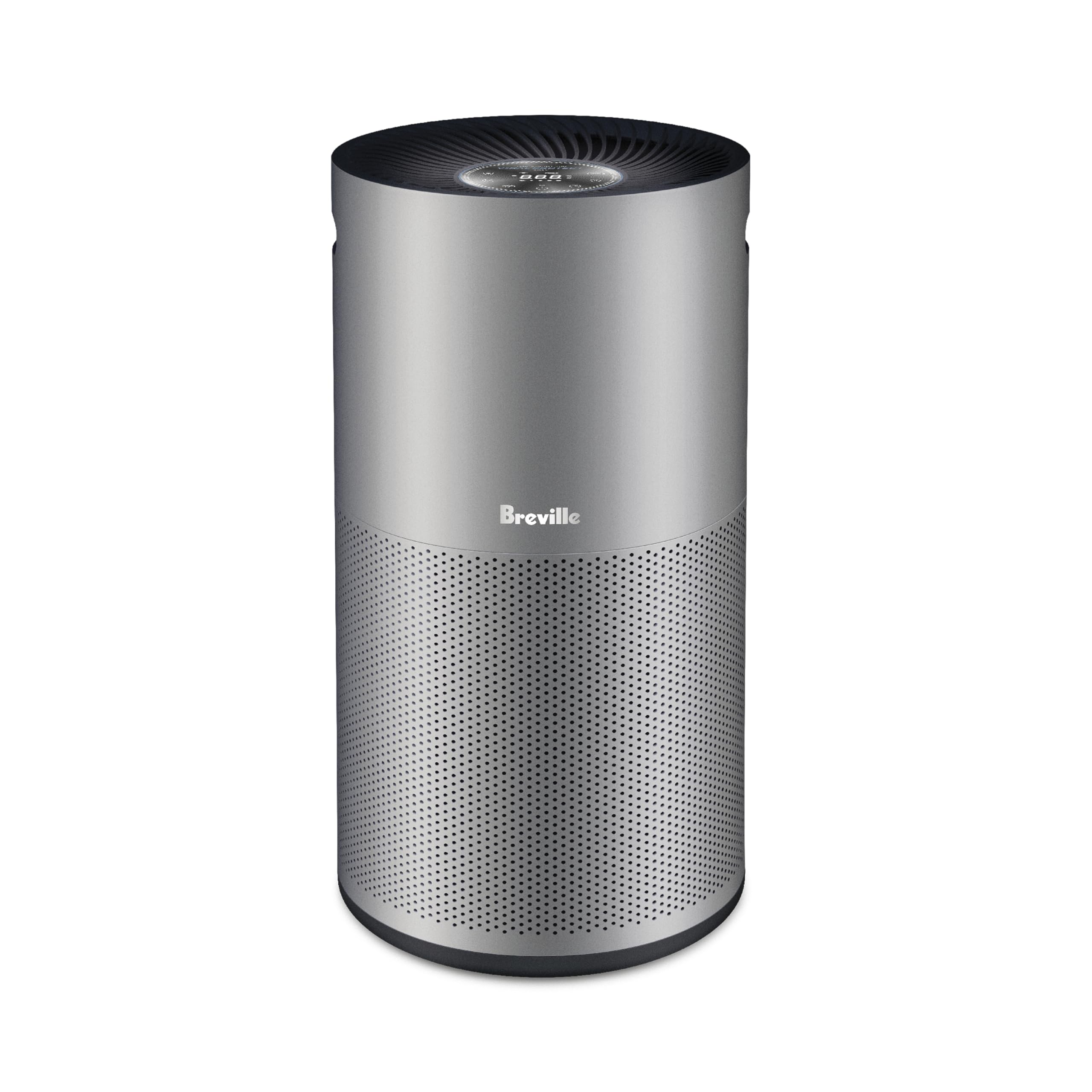
Current AU specifications list 290 × 290 × 535 mm, 46 W and a 26 dB Night Mode claim, plus a three-year limited warranty. The noise value is mode-specific and the wattage is not used as a universal running-cost ranking.
The cleanest airflow anchor is 530 m³/h. The separate 138 m² manufacturer coverage claim is useful manufacturer guidance, but it does not mean every room of that floor area will receive the same air-change rate. Ceiling height, doors, leakage and the speed at which you want to clear particles all change the practical fit. Use the confirmed airflow number for comparison, then check the actual room volume and use case.
The control experience is app control, automatic operation and PM2.5 sensing. Automatic sensing can be genuinely useful when particle levels vary through the day, while app control only earns weight if you will schedule, monitor or adjust the purifier remotely. If your plan is to run one fixed fan speed, room fit, noise and maintenance should outrank connectivity.
For ownership planning, the published noise context is 26 dB published minimum, and filter replacement is about 12 months; the current product record does not resolve a reliable annual replacement-filter cost. Treat those figures as practical inputs, not as proof of cleaning quality. Bedroom buyers should care about the sound level at the fan speed they will actually use, while filter-life claims should always be read with their stated conditions rather than converted into guaranteed years of maintenance-free operation.
The filtration path is particle filtration, activated carbon and a switchable UV/Microbe Shield treatment stage. That should be read as an architecture choice: particle filtration handles airborne particles, carbon can contribute to odour and gas treatment, and additional electrostatic or UV stages should only influence the decision when you actually want that technology. It is a premium-priced purifier, and filter-material or treatment claims should not be read as proof of clinical whole-room efficacy.
Owner views
Early owner feedback
4.8 ★· 35 source ratings
Source rating · The Good Guys AU
Owner evidence snapshot
Most-mentioned themes in exact-model Australian owner evidence.
Noise & sleep use
Positive signal
Ease of use
Positive signal
Air-quality improvement
Positive signal
Who should choose something else
The LAP608 is easiest to justify when its airflow and connected workflow are both useful. If either is unnecessary, another model can be a cleaner fit.
- Compare the Coway Airmega 400 when you want higher confirmed airflow and can live without an app.
- Compare the Levoit Core 400S when 433 m³/h plus a deep smart-control workflow is enough for the room.
- Compare the Dyson HushJet when compact placement and published acoustics matter more than having a confirmed CADR.
PIQSY conclusion
Buy it if
Choose the Breville LAP608 when 530 m³/h confirmed CADR, connected control, switchable treatment and a three-year AU warranty fit the room and the way you will operate it.
Skip it if
Skip it when a smaller purifier already meets the airflow job, when the connected layer would go unused, or when you were treating Breville's room-area or antiviral language as stronger evidence than it is.
The durable reason to buy this model is the combination of confirmed airflow + useful control, not mutable price, ratings or marketing intensity.
The practical buying rule is to choose the Breville Smart Air Viral Protect Max LAP608 when its room-size evidence, control style, maintenance burden and filtration architecture all fit the same use case. If you need to reinterpret a low-ACH coverage claim, ignore an unresolved airflow figure, or pay for controls you will not use just to make the fit, another purifier is the cleaner choice.
Final decision
Ready to choose, or want one more check?
Buying options
Check the current offer.
$498 AUD
Prices and availability can change.
Quick answers
Frequently asked questions
Who is the Breville the Smart Air Viral Protect Max Air Purifier best for?
Larger rooms
How should I size the Breville the Smart Air Viral Protect Max Air Purifier?
The published CADR figure PIQSY uses is 530 m³/h. Treat it as one decision input alongside the practical trade-offs in the Verdict, not as a universal ranking.
When should I choose something else instead of the Breville the Smart Air Viral Protect Max Air Purifier?
Tight budgets
What is PIQSY's short read on the Breville the Smart Air Viral Protect Max Air Purifier?
PIQSY assesses Breville the Smart Air Viral Protect Max Air Purifier using its resolved 530 m³/h CADR, connected controls, switchable Microbe Shield, filter guidance and current AU support evidence.
Technical detail
Specifications
See full specifications
| Cadr M3h | 530 |
|---|---|
| Cadr Published Low M3h | 530 |
| Cadr Published High M3h | 530 |
| Cadr Conflict | No |
| Manufacturer Coverage M2 | 138 |
| Noise Min Db | 26 |
| Filter Life Months | 12 |
| Power | 46 W |
| Has Activated Carbon | Yes |
| Has Particle Filter | Yes |
| Has Ionisation | No |
| Ionisation Switchable | No |
| Has Electrostatic Filtration | No |
| Has UV | Yes |
| Uv Switchable | Yes |
| Has App | Yes |
| Has Auto Mode | Yes |
| Has Pm25 Sensor | Yes |
| Sensitive Choice Approved | No |
| Choice Tested Exact Model | No |
Keep Exploring
Research provenance
See how PIQSY verified this recommendation.
Research provenance
See how PIQSY verified this recommendation.
How we checked this
How PIQSY checked this product
We checked the Australian model and dated manufacturer or retailer sources rather than borrowing specifications from an overseas variant.
Australian model checked
LAP608TTM2IAN1
Sources used
Manufacturer · Amazon AU
Sources checked through 25 Aug 2026
Last checked
6 Sept 2026
Price checked 25 Oct 2026
Hands-on testing: PIQSY has not physically tested this product for this page unless hands-on testing is explicitly disclosed.
What we could and couldn’t verify: If specifications conflict, cannot be matched to the Australian variant or cannot be confirmed, we leave them unresolved rather than guessing. Owner feedback is shown only when we can attribute it to the product we checked.
See models and source details
Sources used
- Manufacturer · breville.com · checked 25 Aug 2026
- Amazon AU · amazon.com.au · checked 18 Aug 2026