
PIQSY Compare
Ninja Foodi Max XXXL Dual Zone Air Fryer 9.5L vs Ninja DoubleStack XXXL 9.5L 2 Drawer Air Fryer
Compare Ninja's two 9.5L dual-zone formats: the side-by-side AF400 and narrow stacked SL400, with the width, depth and cooking-workflow trade-offs that actually change the decision.
The choice that matters
Choose the side-by-side Ninja for wider drawer access.
Choose the stacked Ninja to save bench width.

Decision snapshot
Start with how you’ll use it.
Ninja
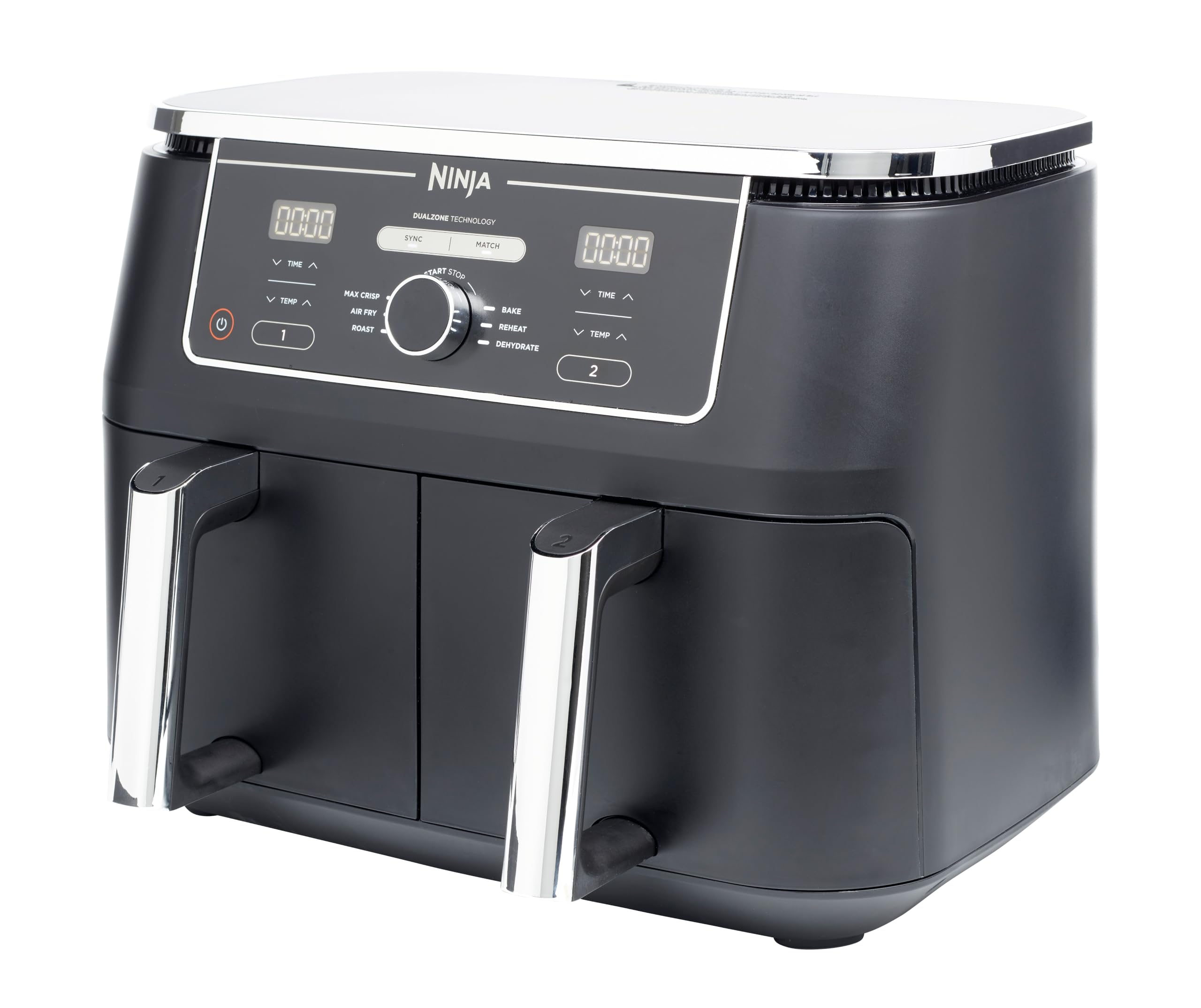
Ninja Foodi Max XXXL Dual Zone Air Fryer 9.5L
Best fit: Straightforward side-by-side access
Biggest reason: Two equal 4.75L zones
Main compromise: Wide footprint
Ninja
Ninja DoubleStack XXXL 9.5L 2 Drawer Air Fryer
Best fit: Width-constrained benches
Biggest reason: 9.5L capacity in a narrower stacked design
Main compromise: Premium price relative to conventional dual-drawer models
Key differences
The key differences at a glance.
These confirmed specifications differ. The advice below explains which ones matter for your needs.
Dual basket
Stacked dual basket
41.5 × 33 × 38 cm
28.6 × 48.8 × 38.5 cm
1670W
2270W
Dual basket
Stacked dual basket


What matters when choosing
What you'll actually notice
Choose the Ninja AF400 when you have enough horizontal bench space and want the most conventional two-drawer workflow: two equal 4.75L baskets sitting side by side with straightforward access.
Choose the Ninja SL400 DoubleStack when horizontal width is genuinely the constraint and its deeper vertical layout works in the space you actually have.
Both give you 9.5L total capacity across two 4.75L drawers. This is therefore not a capacity-upgrade decision. It is a question of where you want the appliance to occupy space and how much cooking-layer complexity you want.
What changes the choice
The SL400 saves width, not overall appliance volume
The AF400 measures 41.5cm wide × 33cm deep. The SL400 measures 28.6cm wide × 48.8cm deep.
That makes the SL400 materially narrower, but also much deeper. A kitchen with limited left-to-right space may suit the SL400 extremely well; a shallow bench or a location where the appliance already projects forward may favour the AF400 instead.
So the useful question is not “which one is smaller?” It is which dimension is actually constrained in your kitchen?
The AF400 is the simpler drawer interaction
The AF400 keeps both drawers at the same height and beside each other. If you want to load, check and empty two baskets with minimal change from a conventional dual-drawer format, that is its structural advantage.
The SL400 stacks the zones vertically. That architecture is the reason it saves width, but it changes how you reach and manage the two drawers.
SL400's meal racks add a different kind of flexibility
The SL400 includes two stacked meal racks, giving you two cooking levels per drawer when that arrangement is useful. PIQSY treats those racks as added placement flexibility, not as proof that the SL400 cooks more food better or faster.
If multi-level cooking is appealing, the racks can be a genuine reason to choose the stacked design. If you mostly want two simple baskets, the AF400 keeps the workflow more conventional.
Equal-zone cooking stays the same core proposition
Neither model solves an asymmetric main-and-side problem better by capacity alone: both use two equal 4.75L drawers. If your normal meal is one large main plus a much smaller side, compare this format with the Philips NA352's 6L + 3L layout.
If one uninterrupted cooking area is the missing capability, neither fixed two-drawer design provides it; the Ninja AF500 FlexDrawer is the more relevant comparison.
What this means: Both give you 9.5L total across two equal 4.75L zones, so capacity and basic dual-zone logic do not decide this comparison. The meaningful difference is geometry: AF400 spreads the drawers side by side, while SL400 stacks them into a 28.6cm-wide body and reaches much deeper on the bench.
Switch when: Choose AF400 when conventional side-by-side access fits your kitchen and you value the simpler drawer interaction. Choose SL400 when horizontal width is the hard constraint and you are comfortable trading that width saving for extra depth and the stacked access pattern.
The practical choice
Measure width and depth separately. AF400 is 41.5cm wide and 33cm deep; SL400 is 28.6cm wide and 48.8cm deep. Calling the SL400 simply 'smaller' hides the actual trade: it saves a lot of horizontal space but asks for substantially more depth.
After fit, think about how you load food. AF400 keeps both drawers at the same level and is easier to read at a glance. SL400 adds meal racks and vertical stacking options, which can be useful when you genuinely want to arrange more than one food within a zone. Those racks add flexibility, not extra litre capacity, so they should reinforce a stacked-layout preference rather than create one.
When to choose AF400
- you have enough horizontal bench width;
- side-by-side drawer access feels more natural;
- two equal 4.75L zones already cover your meals;
- you do not need the SL400's multi-level racks to justify a more involved layout.
When to choose SL400
- bench width is a hard constraint;
- 48.8cm depth is still workable in the intended location;
- you still want two equal 4.75L zones;
- the stacked meal racks add useful cooking flexibility for you.
Choose neither when
Choose neither if two fixed 4.75L zones are the wrong meal shape. An asymmetric 6L + 3L layout suits a larger main plus smaller side, while a convertible drawer is better when you sometimes need one uninterrupted cooking area.
PIQSY conclusion
Choose the AF400 for the more conventional side-by-side dual-zone workflow when width is available.
Choose the SL400 DoubleStack when saving horizontal width is a real kitchen requirement and you are comfortable trading that width saving for greater depth and a stacked, potentially more involved workflow.
Neither is universally more compact or more capable. The deciding factor is the shape of your available bench space and the way you want to access the two zones.
Final choice
Choose the one that fits your needs.
Ninja
Ninja Foodi Max XXXL Dual Zone Air Fryer 9.5L
Choose when: Straightforward side-by-side access
Ninja
Ninja DoubleStack XXXL 9.5L 2 Drawer Air Fryer
Choose when: Width-constrained benches
Specifications
Compare the full specifications.
Specifications
Compare the full specifications.
Dual basket
Stacked dual basket
9.5L
9.5L
41.5 × 33 × 38 cm
28.6 × 48.8 × 38.5 cm
2 years
2 years
1670W
2270W
Max Crisp, Air Fry, Roast, Bake, Reheat, Dehydrate
Unverified
Dual basket
Stacked dual basket
40°C-240°C
Unverified
8.8kg
Unverified
Unverified
2 x 4.75L
Unverified
6 cooking functions
Unverified
Vertical stacked drawers
Keep comparing
Related comparisons worth checking.
Still not clear?
Let your own priorities break the tie.
How we checked this
See the Australian models and sources PIQSY checked for this page.
How we checked this
See the Australian models and sources PIQSY checked for this page.
How we checked this
How PIQSY checked this page
We checked the Australian model and dated manufacturer or retailer sources rather than borrowing specifications from an overseas variant.
Australian model checked
2 Australian models checked
Sources used
Manufacturer · Amazon AU
Sources checked through 18 Aug 2026
Last checked
28 Aug 2026
Current price and availability are checked separately where shown.
Hands-on testing: PIQSY has not physically tested this product for this page unless hands-on testing is explicitly disclosed.
What we could and couldn’t verify: If specifications conflict, cannot be matched to the Australian variant or cannot be confirmed, we leave them unresolved rather than guessing. Owner feedback is shown only when we can attribute it to the product we checked.
See models and source details
- Ninja Foodi Max XXXL Dual Zone Air Fryer 9.5L: AF400ANZ
- Ninja DoubleStack XXXL 9.5L 2 Drawer Air Fryer: SL400
Sources used
- Manufacturer · sharkninja.com.au · Ninja Foodi Max XXXL Dual Zone Air Fryer 9.5L · checked 18 Aug 2026
- Amazon AU · amazon.com.au · Ninja Foodi Max XXXL Dual Zone Air Fryer 9.5L · checked 18 Aug 2026
- Manufacturer · sharkninja.com.au · Ninja DoubleStack XXXL 9.5L 2 Drawer Air Fryer · checked 12 Aug 2026
- Amazon AU · amazon.com.au · Ninja DoubleStack XXXL 9.5L 2 Drawer Air Fryer · checked 15 Aug 2026