
PIQSY Guide
Portable vs Countertop Blender
Compare portability, power access, capacity and cleaning before choosing a blender.
The decision this guide answers
Compare portability, power access, capacity and cleaning before choosing a blender.
Choose a portable blender if you genuinely need to mix a drink somewhere without a power point. For family portions, regular use at home or tougher recipes, begin with a countertop blender. If you make your smoothie at home and only carry it to work, a plug-in personal blender with a travel cup may be the simpler choice. The ingredients you use and the amount you make still matter more than the label on the box.
First decide where blending actually happens
It is easy to picture a smoothie at the gym or on a picnic. But if most drinks are made at home before work, the ability to recharge a blender may add less value than you expect. A countertop machine needs a power point and somewhere to live, but you can use it without planning around battery charge. A portable unit is useful when the blend itself must happen elsewhere, not merely when you want to carry a finished drink.
There is also a third option worth considering: a plug-in personal blender with a travel cup. It can blend on the kitchen bench and let you take the drink with you. For someone who always blends at home, that may be more convenient than carrying a battery-powered appliance, motor and blades to the office.
What portable blenders do well
Portable blenders are built around convenience and smaller servings. They can suit simple fruit drinks, protein shakes and mixtures that the instructions for the model you choose permit. Their compact form may work well in a small kitchen, shared accommodation or a workspace where a large appliance is impractical. Some designs let you drink from the same vessel, reducing the number of containers needed.
Their biggest advantage is flexibility, but flexibility has conditions. A portable blender must be charged, cleaned and carried. The motor section may make the bottle heavier than an ordinary drink container. If you are travelling with it, you also need to consider leak prevention, blade protection and any transport restrictions that apply to its battery. Check the specific manufacturer's travel and charging guidance rather than assuming all portable designs behave alike.
Portable does not necessarily mean waterproof. A bottle may be washable while its charging port and motor base must stay dry. Check the manual before putting any powered component under a tap or in a dishwasher.
What countertop blenders do well
A countertop blender is more appropriate when blending is a regular kitchen task rather than an occasional convenience. Full-size jugs can serve more people and make it easier to prepare sauces, smoothies or purées in batches. Some models support demanding ingredients and specialised recipes, but capability varies greatly. A budget countertop blender is not automatically stronger than every portable machine simply because it plugs into the wall.
The key advantage is having a machine designed for repeated kitchen use without battery planning. Larger jugs and accessible controls can also be easier when you adjust recipes or add ingredients. The compromise is bench space, storage and cleaning. A full-size jug may be unnecessarily cumbersome for one small shake, especially if you need to wash it before leaving home.
Look at the actual vessel you would use each day. A model that includes personal cups can offer much of the convenience of a smaller blender while keeping a countertop motor base. But check whether the personal cup is included or sold separately, and whether it uses a different blade assembly.
Which type fits you?
Use these examples to compare where and how you blend. They illustrate the formats; their final suitability depends on the exact product and recipe.
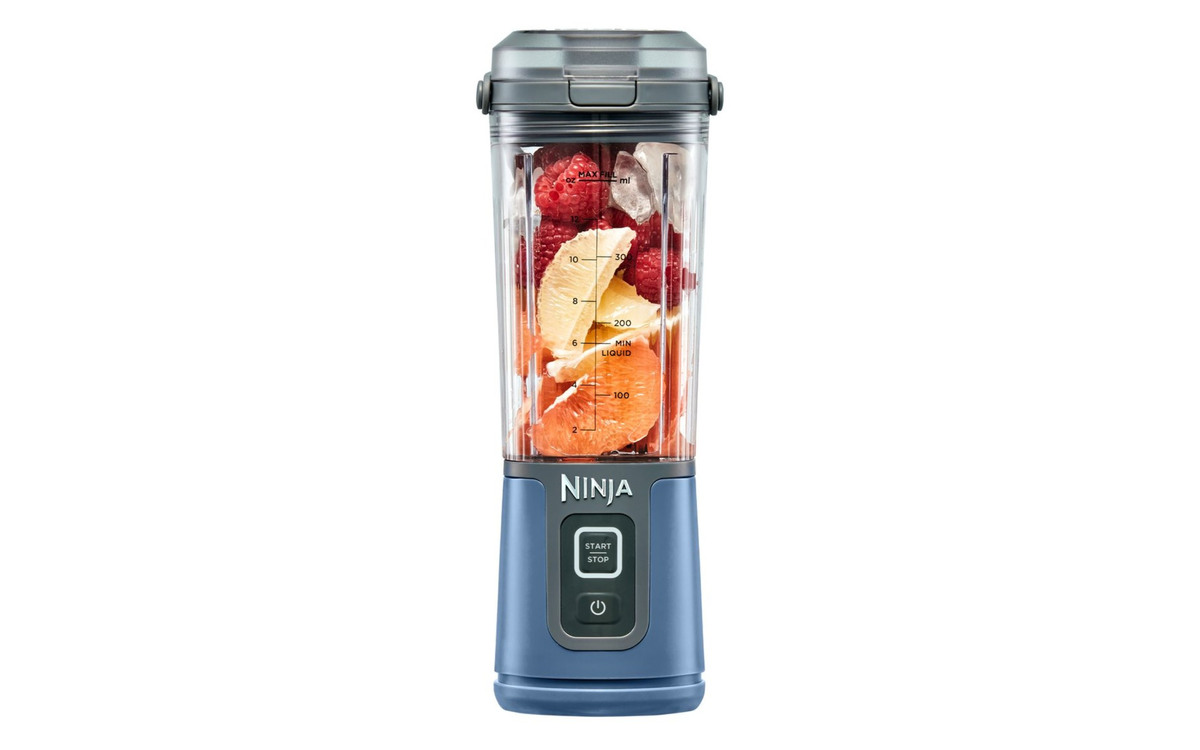
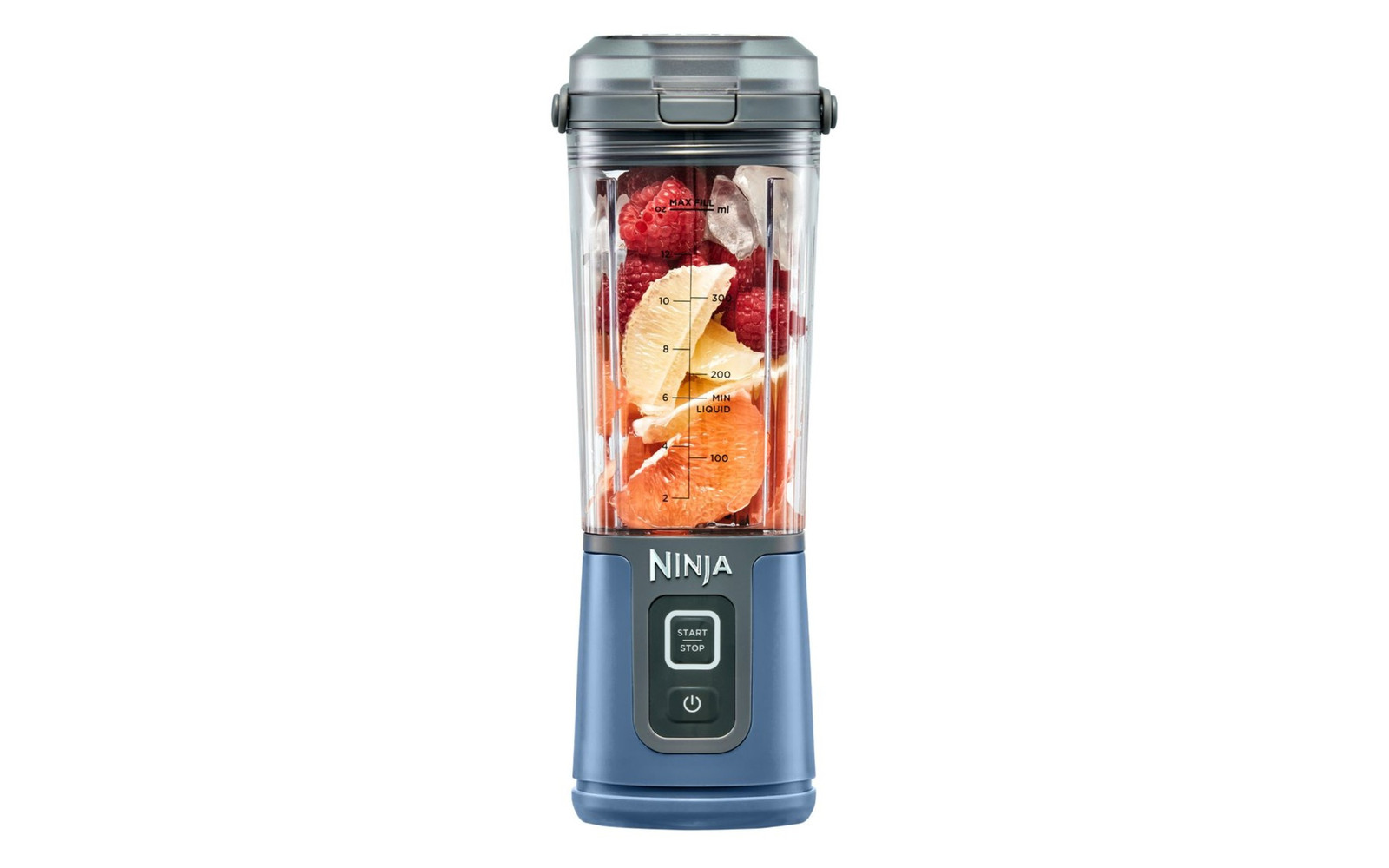
Basic cordless travel
Ninja Blast Portable Blender BC100NV Denim BlueSmall single-serve smoothies away from a wall socket

Larger cordless cup
Ninja Blast Max Cordless Portable BlenderLarger personal smoothies without access to a socket

Mains-powered personal
NutriBullet 900 Mega PackDaily individual smoothies for more than one household member

The ingredients test
Soft fruit and protein powder
If your normal drink is milk, yoghurt, soft fruit and protein powder, a portable model may be sufficient if the manufacturer supports those ingredients and quantities. Texture can still vary, especially when ingredients are packed tightly or there is not enough liquid. Consider whether the drink must be perfectly smooth or simply well mixed.
Frozen fruit and ice
Frozen ingredients are where assumptions become expensive. A product image showing ice does not establish that every portable blender can process hard frozen cubes safely or repeatedly. Some models require small pieces, a minimum liquid level or a specific loading order. Others may restrict ice entirely. Read the exact manual and avoid treating marketing wattage as a substitute for permitted-use instructions.
Countertop blenders also differ. If frozen smoothies are a daily habit, look for independently assessed performance on similar recipes and confirm the manufacturer's limitations. A larger jug does not guarantee a lump-free result.
Thick smoothie bowls and nut butter
Dense mixtures need ingredients to keep moving through the blades. When a blender stalls, adding more liquid may rescue the blend but change the recipe. Certain countertop machines include tampers or programs intended for thicker preparations; these are not universal. Small portable cups are rarely the obvious first choice for heavy, low-liquid recipes. If thick dips and nut butter dominate your cooking, compare a food processor too.
Soups and warm liquids
Do not assume a portable blender can take hot soup. Heat and pressure can create a serious risk in sealed vessels, and manufacturer restrictions differ. Even countertop models need their specific hot-liquid instructions followed, including cooling, venting and fill limits where applicable. A stick blender used safely in a suitable pot may be a more convenient alternative for soups.
How many serves do you need?
Capacity is not just the number printed on the bottle or jug. The safe maximum fill line can be lower, and frozen fruit may take up space before liquid is added. If you make a drink for two adults every morning, a tiny portable cup could mean blending twice, cleaning more often and waiting for another cycle. That may erase the convenience advantage.
For one simple drink, a small vessel can reduce waste and cleanup. For family breakfasts or batch preparation, a larger countertop jug usually makes more sense. Check usable capacity for the specific recipe, not merely the advertised container volume.
Battery life, charging and travel
A portable blender adds a routine that countertop machines do not have: keeping it charged. Published blends-per-charge figures depend on ingredients, temperature and how long the motor runs, so treat them as manufacturer estimates unless independently tested. Think about whether you can reliably recharge it between uses and whether the charging connector suits your everyday setup.
For commuting, consider the complete carried weight, not just the empty cup. Add the ingredients, lid and motor assembly. Ask whether you truly need to blend at your destination. If not, making a drink at home and carrying it in a sealed bottle may be lighter and simpler.
For holidays and flights, check the relevant carrier's lithium-battery rules and the appliance manufacturer's instructions before packing. Do not assume a rechargeable kitchen appliance is treated exactly like an ordinary water bottle.
Cleaning and ongoing use
Convenience disappears quickly when a blade assembly is awkward to clean. Check whether the cup, lid, gasket and blade unit can be separated safely, and which parts are dishwasher-safe. A portable motor base often requires more care around charging contacts. A countertop jug may be larger to wash but easier to reach into once disassembled according to instructions.
Avoid leaving dairy or protein mixtures in either type of blender for long periods. Wash food-contact parts promptly, dry them thoroughly and inspect seals for trapped residue. Replacement seals and cups matter if you plan to keep the appliance for years. Check local availability rather than assuming a universal part will fit.
Three realistic buyer profiles
The gym commuter: You make one basic shake and want to blend shortly before drinking. A portable model could suit you, provided you are comfortable carrying the motor, charging it and cleaning it afterwards. If you only want to transport a prepared shake, consider a plug-in personal blender and travel bottle instead.
The family breakfast maker: You prepare multiple smoothies, often with frozen ingredients. A countertop jug is the more natural starting point. Look for appropriate batch size, supported frozen-fruit use and an easy daily cleaning routine. A portable blender may become an occasional second appliance, not the main one.
The small-apartment cook: You want a smoothie most mornings and sometimes make sauces. Either type could work. If you have a power point and blend at home, a compact countertop or plug-in personal model avoids battery upkeep. Choose portable only if blending away from home is a genuine repeated need.
Before buying either type
Start with your usual recipe, serving size and blending location. Check the exact Australian model's ingredient restrictions, safe fill line, charging or power requirements, warranty terms and cleaning instructions. Look for independent tests of texture and noise where available. Avoid assuming a higher price or headline power figure guarantees a smoother result.
If you expect to blend on the go several times a week, portable convenience may be worth the compromises. If you mostly prepare drinks at home, need larger batches or regularly use demanding ingredients, begin with a countertop option. And if you simply want to carry a smoothie, you may not need a battery-powered blender at all.
Compare the closest choices
Move from the format to the actual product decision.
Apply what you learned
Turn the trade-off into a shortlist that fits you.
Keep Exploring
How we checked this
See the Australian models and sources PIQSY checked for this page.
How we checked this
See the Australian models and sources PIQSY checked for this page.
How we checked this
How PIQSY checked this page
We checked the Australian model and dated manufacturer or retailer sources rather than borrowing specifications from an overseas variant.
Australian model checked
4 Australian models checked
Sources used
Amazon AU · Manufacturer · Australian retailer
Sources checked through 16 Oct 2026
Last checked
18 Oct 2026
Current price and availability are checked separately where shown.
Hands-on testing: PIQSY has not physically tested this product for this page unless hands-on testing is explicitly disclosed.
What we could and couldn’t verify: If specifications conflict, cannot be matched to the Australian variant or cannot be confirmed, we leave them unresolved rather than guessing. Owner feedback is shown only when we can attribute it to the product we checked.
See models and source details
- Breville the Fresh & Furious: BBL620
- Ninja Blast Portable Blender BC100NV Denim Blue: BC100NV
- Ninja Blast Max Cordless Portable Blender: BC251NV
- NutriBullet 900 Mega Pack: NB9-1107AK
Sources used
- Amazon AU · amazon.com.au · Breville the Fresh & Furious · checked 11 Oct 2026
- Manufacturer · appliancesonline.com.au · Breville the Fresh & Furious · checked 16 Oct 2026
- Manufacturer · sharkninja.com.au · Ninja Blast Portable Blender BC100NV Denim Blue · checked 16 Oct 2026
- Australian retailer · thegoodguys.com.au · Ninja Blast Portable Blender BC100NV Denim Blue · checked 16 Oct 2026
- Manufacturer · sharkninja.com.au · Ninja Blast Max Cordless Portable Blender · checked 13 Oct 2026
- Amazon AU · amazon.com.au · Ninja Blast Max Cordless Portable Blender · checked 11 Oct 2026
- Manufacturer · bulletbrands.com.au · NutriBullet 900 Mega Pack · checked 13 Oct 2026
- Amazon AU · amazon.com.au · NutriBullet 900 Mega Pack · checked 11 Oct 2026
- Manufacturer · nutribullet.co.uk · NutriBullet 900 Mega Pack · checked 16 Oct 2026